The Complete Legends of Zhong Kui: From Tragic Scholar and Demon-Quelling Deity to Black Myth: Zhong Kui Lore Analysis
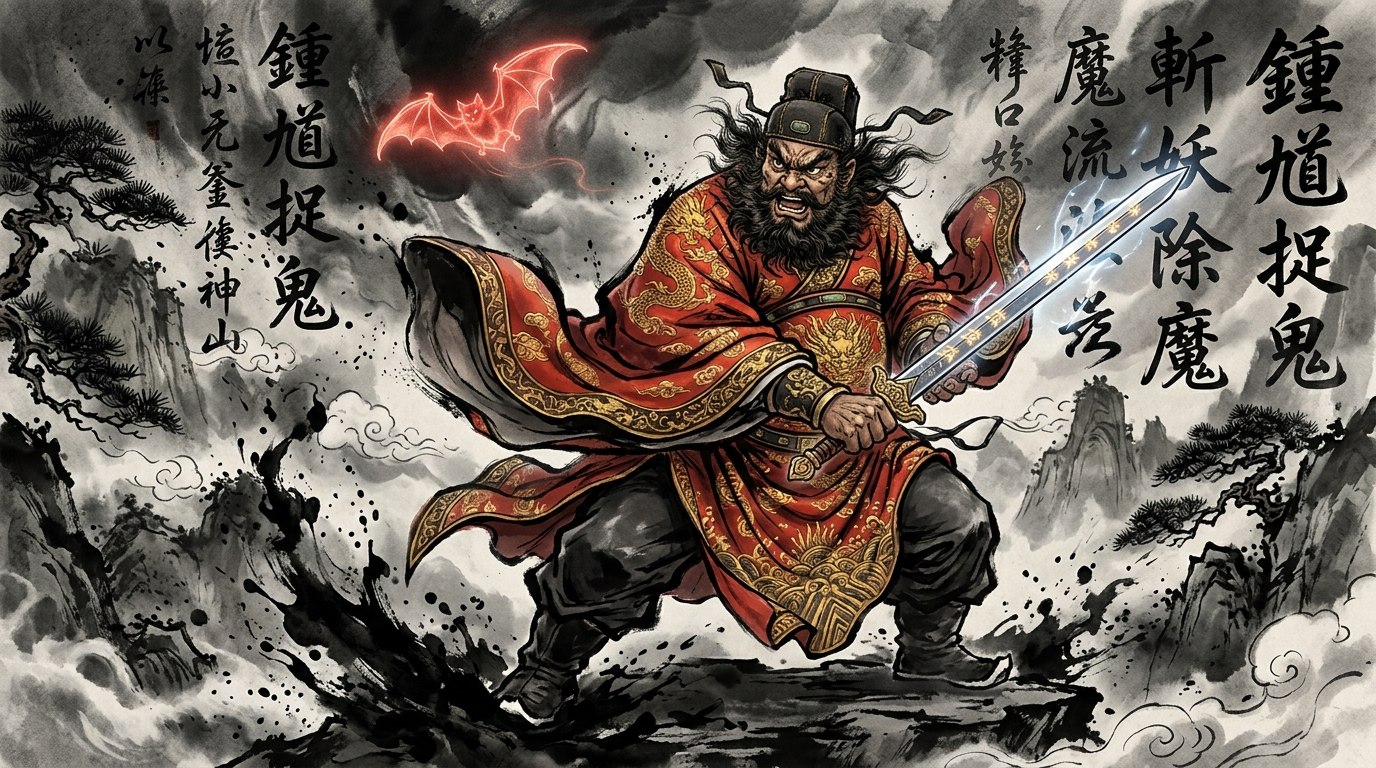
The Complete Legends of Zhong Kui: From Tragic Scholar and Demon-Quelling Deity to Black Myth: Zhong Kui Lore Analysis
Zq.Lucifer🌐 Language / 语言版本:
🇬🇧 [Current Page] English Version | 🇨🇳 [阅读中文版] 钟馗民间传说全集:从终南书生、赐福镇宅真君到《黑神话:钟馗》角色深度考据
Introduction: The All-Answering Guardian and Demon-Quelling Totem
In the vast pantheon of Chinese folklore and Taoist mythology, Zhong Kui (courtesy name Zhengnan) stands as one of the most dramatically compelling and emotionally resonant deities. Bridging the wrathful countenance of an underworld guardian with the benevolence of a household protector, he is revered both as the Demon-Quelling True Sovereign (Qu Mo Zhen Jun) who strikes terror into malevolent spirits, and the Supreme Lord of Blessing and House-Guarding (Ci Fu Zhen Zhai Sheng Jun).
From ancient exorcism rituals involving the peach-wood club (Zhongkui) in pre-Tang dynasties, to the imperial paintings by the Tang Dynasty’s “Sage of Painting” Wu Daozi, to centuries of folk theater and Nuo dances, the legends of Zhong Kui form an epic tapestry combining Confucian martyrdom, Taoist cosmic order, and deeply human loyalty.
This article compiles the canonical folklore surrounding Zhong Kui and concludes with an in-depth narrative analysis of the upcoming action RPG Black Myth: Zhong Kui, exploring why the scholar companion featured in the concept footage is almost certainly his folkloric sworn brother, Du Ping.
1. Origins: Injustice at Court and Tragic Deification
1.1 The Brilliant Prodigy of Mount Zhongnan
According to legend, Zhong Kui was a scholar living at the foot of Mount Zhongnan (in modern-day Shaanxi Province) during the Tang Dynasty. Physically, he possessed an intimidating appearance—described as having “a leopard-like head, round piercing eyes, an iron-dark face, and a bristling curly beard.” Despite his fearsome exterior, Zhong Kui was an intellectual and martial prodigy, blessed with peerless literary genius, mastery of military strategy, and unyielding moral righteousness.
1.2 Betrayal in the Gold Dragon Hall
During the imperial civil service examinations, Zhong Kui traveled to the imperial capital of Chang’an alongside his closest friend and fellow townsman, Du Ping. The chief examiner was astonished by Zhong Kui’s essay, proclaiming him a generational genius and naming him the Zhuangyuan (Top Imperial Scholar).
However, during the formal Palace Examination (Dianshi) inside the Imperial Gold Dragon Hall, a treacherous prime minister (traditionally identified in folklore as Lu Qi) slandered him before the Emperor: “The Zhuangyuan represents the imperial prestige of the realm. Parading such a hideous man through the capital and having him receive foreign envoys would bring dishonor upon the Great Tang.”
Swayed by prejudice and deceit, the Emperor stripped Zhong Kui of his rightful title. When Zhong Kui passionately defended his honor in court, the minister mocked him and ordered the guards to throw him out. Consumed by righteous fury and despair, Zhong Kui shouted toward the heavens: “When the world turns upside down, there is no place for the upright!” In a final act of unyielding protest, he hurled himself against the palace’s nine-dragon jade pillars, dying instantly as his blood stained the imperial steps.
1.3 Imperial Burial and Divine Ascension
Risking imperial displeasure, his loyal friend Du Ping gathered Zhong Kui’s remains and spent his own family fortune to provide him with an honorable burial.
Moved by his heroic spirit and tragic fate, the Celestial Jade Emperor (and the King of the Underworld) decreed that Zhong Kui be elevated to divine status. He was bestowed the title of Demon-Quelling True Sovereign and Supreme Lord of Blessing and House-Guarding, gifted the Seven-Star Cyan Blade Sword, and granted command over legions of netherworld soldiers to purge the mortal realm of all wicked spirits.
2. Underworld Status: The “Eight Lords” Hierarchy and Martial Judge Zhong Kui (Wu Er Ye)

2.1 The Strict Hierarchy of the Underworld’s “Eight Lords” (Ba Wei Ye)
In traditional Chinese netherworld mythology and Taoist folk beliefs, beyond the Ten Kings of Hell (Shi Dian Yan Luo) and City Gods (Cheng Huang), the core executive deities tasked with arresting, prosecuting, and punishing souls are collectively known as the “Eight Lords” (Ba Wei Ye / The Eight Great Underworld Marshals). Their traditional seating order and administrative rankings are strictly defined:
- First & Second Lords (Civil & Martial Judges / Wen Wu Pan Guan):
- Civil Judge Cui Jue (Wen Er Ye / The Civil Second Master): Seated on the Left in red judicial robes, holding the Life-and-Death Ledger (Sheng Si Bu) and the vermilion brush; responsible for auditing human merits and sins, recording life spans, and drafting judgment decrees.
- Martial Judge Zhong Kui (Wu Er Ye / The Martial Second Master): Seated on the Right with a fierce leopard-eyed countenance, presiding over the Evil-Punishing Tribunal (Fa E Si); wielding the Seven-Star Cyan Blade Sword to interrogate, arrest vicious specters, and execute immediate retributive punishments.
- Third & Fourth Lords (Netherworld Enforcers · Ox-Head & Horse-Face / Niu Tou Ma Mian):
- Third Lord Ox-Head (A-Pang) and Fourth Lord Horse-Face (Luo Cha): Formidable gatekeepers of Hell and the Yellow Springs, clad in heavy armor and brandishing tridents to suppress rebellious demons.
- Fifth & Sixth Lords (Soul-Chaining Generals · Golden Shackle & Silver Lock):
- Fifth Lord Golden Shackle (Jin Jia Jiang Jun) and Sixth Lord Silver Lock (Yin Suo Jiang Jun): Specialized wardens holding nine-ring golden shackles and refined silver locks to bind treacherous and unrepentant spirits attempting escape.
- Seventh & Eighth Lords (Impermanence Deities · Black & White Impermanence):
- Seventh Lord White Impermanence (Xie Bi’an): Wearing a tall hat inscribed “Blessing Upon First Sight,” holding a white feather fan and soul-banner to guide righteous souls;
- Eighth Lord Black Impermanence (Fan Wujiu): Wearing a squat cap inscribed “Peace Across the Realm,” holding iron chains and a soul-reaping rod to drag wicked souls to court.
2.2 Martial Judge Zhong Kui (Wu Er Ye): Judicial Authority and Folk Rituals
- Dual Judicial Authority (Left Civil, Right Martial): While Zhong Kui is venerated as an independent celestial “Demon-Quelling True Sovereign,” within the netherworld court bureaucracy, he is formally incorporated as the Martial Judge of the Evil-Punishing Tribunal (Wu Er Ye). In the underworld halls, Civil Judge Cui Jue (Wen Er Ye) delivers verdict assessments on the left, while Martial Judge Zhong Kui (Wu Er Ye) commands demon-hunting marshals on the right to enforce absolute cosmic retribution.
- Folkloric Exorcism Grounded in the Martial Judge Role: Traditional practices—such as hanging Zhong Kui portraits on Dragon Boat Festival, posting protective talismans during the Seventh Lunar Month (Ghost Month), or performing the masked Nuo Exorcism Dance (Tiao Zhong Kui) at building inaugurations—all stem directly from his terrifying judicial authority as the Underworld’s Martial Second Master.
3. Imperial Manifestation: Emperor Xuanzong’s Nightmare and Wu Daozi’s Painting
Recorded in historical compilations such as Tang Yishi and Shen Kuo’s Dream Pool Essays, this legend cemented Zhong Kui’s place in official court records and widespread domestic worship.
3.1 The Pestilence of the Malicious Imp
Emperor Xuanzong of Tang (Li Longji) fell critically ill with malaria after an imperial military inspection at Mount Li. For over a month, imperial physicians could not break the fever.
One night, during a delirious bout of fever, the Emperor dreamed of two apparitions entering his bedchamber:
- A mischievous imp wearing only breeches darted around the imperial pillars, clutching Imperial Consort Yang Guifei’s embroidered perfume pouch in one hand and Xuanzong’s prized jade flute in the other. When the Emperor rebuked it, the imp snickered: “I am ‘Xu Hao’ (The Demon of Waste and Loss). I steal what mortals cherish, deplete their good fortune, and turn joy into sorrow.”
- Suddenly, with a crash like thunder, a towering figure burst into the hall. Wearing a frayed scholar’s hat, dark blue official robes, and official court boots, the figure seized the imp, gouged out its eyes, tore it limb from limb, and devoured it whole.
3.2 The Oath and the Sacred Portrait
Trembling yet awestruck, the Emperor asked the giant for his name. The spirit bowed and answered:
“I am Zhong Kui, the scholar from Mount Zhongnan. Having failed to claim my honor in life, I took my own life on the palace steps. In gratitude for the honorable burial granted to my bones, I have sworn to rid Your Majesty’s realm of all wasteful demons and pestilence.”
Emperor Xuanzong woke up in a cold sweat, discovering that his malaria had vanished completely. At daybreak, he summoned the celebrated painter Wu Daozi and described the vision. Working with breathtaking precision, Wu Daozi captured the fierce deity on silk in a single sitting. The Emperor marveled: “Did you share my very dream? The likeness is miraculous!”
The Emperor immediately decreed that copies of the portrait be distributed throughout the empire, establishing the enduring custom of hanging Zhong Kui’s image on New Year’s Eve to banish evil.
4. Compassion and Honor: Zhong Kui Marries Off His Sister
The tale of “Zhong Kui Marrying Off His Sister” (Zhong Kui Jia Mei) is the most tender and celebrated chapter in the lore, immortalized across centuries in classical Chinese opera.

4.1 Unwavering Gratitude
Even after becoming the King of Demons, Zhong Kui could not forget two earthly bonds: his debt of gratitude to his friend Du Ping, and his worry for his virtuous younger sister, who was left alone in the mortal world. Knowing Du Ping to be an upright, unmarried gentleman, Zhong Kui resolved to transcend the boundary of life and death to unite them in marriage.
4.2 The Ghostly Bridal Procession
On New Year’s Eve amidst a heavy snowfall, Zhong Kui led his supernatural entourage back to his earthly hometown:
- Guiding Lanterns: Little imps carried glowing red lanterns to illuminate the desolate mountain roads;
- Spectral Music: A troupe of imps played joyful tunes on suonas and drums, transforming eerie mist into festive celebration;
- Generous Dowry: Retinue demons shouldered heavy chests of bridal dowry;
- Royal Escort: Zhong Kui, clad in a magnificent red judge’s robe and mounted on a fiery steed, rode beside his sister’s bridal sedan chair with brotherly gentleness.
Arriving at Du Ping’s residence, Zhong Kui greeted his old companion: “In life, you gave me honor; in death, I entrust you with my dearest sister.” Du Ping gladly accepted, and the wedding was solemnized under candlelight. As the morning rooster crowed, Zhong Kui bade them a heartfelt farewell and dissolved into clouds, leaving behind a household blessed with perpetual peace.
5. Seasonal Exorcism: Slaying the Five Venomous Creatures on Dragon Boat Festival
While Zhong Kui is venerated during the Lunar New Year, the fifth day of the fifth lunar month (Dragon Boat Festival) marks his peak exorcism season.
5.1 The Toxic Month
In traditional Chinese cosmology, the fifth lunar month was known as the “Poison Month,” when summer heat and humidity spawned diseases alongside the Five Venomous Creatures: the Scorpion, Viper, Centipede, Gecko, and Toad.
5.2 The Lightning Strike of the Demon Hunter
Commissioned by Heaven, Zhong Kui descended wielding his Seven-Star Cyan Blade Sword:
- He severed the stinger of the giant scorpion demon and incinerated the toxic miasma of the serpent spirit with celestial fire;
- He unleashed his Qiankun Purple-Gold Gourd, sucking the lurking centipedes, geckos, and toad fiends into the gourd where they melted into clear water.
He instructed mortals to hang mugwort and calamus on their lintels, drink realgar wine, and display the True Image of Zhong Kui Subduing Demons. Hence the enduring proverb: “Hang Zhong Kui on Dragon Boat Day, and ten thousand venoms turn away.”
6. Subduing the Five Demons: Taming Chaos into Service
Folk woodblock prints and shadow puppetry frequently depict the humorous motif of “Five Demons Frolicking with Zhong Kui” (Wu Gui Nao Zhong Kui).
Five mischievous spirits roaming the mortal realm (Clever Imp, Prankster Imp, Gluttonous Imp, Lazy Imp, and Miserly Imp) conspired to prank the sleeping deity beneath an ancient tree—one tried to pull his beard, another tried to steal his command seal, and a third attempted to lift his heavy sword.
Zhong Kui, having anticipated their mischief, suddenly released a celestial roar. Terrified by his divine radiance, the five demons fell to their knees and pleaded for mercy. Recognizing that their mischief stemmed from ignorance rather than pure malice, Zhong Kui spared them and recruited them as his loyal attendants:
- Lantern Imp: Holds a palace lantern to illuminate dark netherworld roads;
- Umbrella Imp: Holds a parasol to shield the deity from rain and sun;
- Sword-Bearing Imp: Carries the Seven-Star Cyan Blade Sword;
- Gourd Imp: Shoulders the Qiankun Demon-Catching Vessel;
- Horse-Leading Imp: Guides the reins of the black spirit steed.
This demonstrates the Taoist philosophy of transforming chaos into virtue.
7. Fearless Heroism: Zhong Kui’s Drunken Demon-Quelling
Zhong Kui retained his hearty fondness for wine from his mortal days in Northwest China.
Once, a coven of malevolent fox spirits and demons near Mount Hua attempted to assassinate him by disguising themselves as wealthy elders and hosting a grand banquet with jars of aged wine.
Zhong Kui saw through their deceit immediately. Delighted by the challenge, he drank dozens of jars and feigned drunken stupor upon a stone slab. As the demons drew their daggers, Zhong Kui leaped into the air, performing an astonishing display of “Drunken Eight Immortals” swordcraft. His blade flashed like lightning, slaying every demon before they could comprehend their mistake—a legendary episode celebrated in traditional Chinese opera.
8. The Auspicious Bat: Fortune in Sight and Yearning for Blessings
In traditional iconography, a vibrant red bat is almost always seen hovering above Zhong Kui’s sword:
- The Netherworld Scout: The bat is revered as a spiritual creature capable of piercing the thickest underworld gloom, voluntarily guiding Zhong Kui’s steed toward hidden demon lairs.
- Linguistic Symbolism: In Chinese, “bat” (Fu) is a homophone for “good fortune” (Fu):
- When the bat swoops down directly before his eyes, it represents “Fortune in Sight” (Fu Zai Yan Qian);
- When Zhong Kui gazes longingly toward the sky at the approaching bat, it is titled “Yearning for Fortune’s Arrival” (Hen Fu Lai Chi), expressing the deity’s desire for heavenly blessings to descend upon everyday mortals.
9. Satirical Exorcism: The Grand Marshal of Demon Pacification in Zhan Gui Zhuan
In the Qing Dynasty satirical novel Zhan Gui Zhuan (The Tale of Demon Quelling) by Liu Zhang, Zhong Kui is appointed by King Yama as the Grand Marshal of Demon Pacification. The demons he hunts are not merely supernatural monsters, but allegorical personifications of societal vices and human moral decay:
| Demon Name | Societal Vice / Moral Flaw | Zhong Kui’s Punishment |
|---|---|---|
| The Mischief-Maker (Dao Gui) | Spreading vicious rumors, betrayal, and deceit | Sliced open with the sword to expose the black heart |
| The Reckless Demon (Mao Shi Gui) | Blind arrogance, rash harm to innocent lives | Bound in iron chains and disciplined into order |
| The Petty Demon (Cu Xia Gui) | Malicious spite, profiting at others’ misery | Cast into the Dissolving Cauldron |
| The Hypocrite Demon (Jia Zheng Jing Gui) | Preaching virtue while committing depravity | Unmasked by the Qiankun Mirror and publicly executed |
| The Impatient Demon (Ji Si Gui) | Ruthless impatience, destructive frenzy | Sentenced to silent meditation to purge inner malice |
10. Narrative Speculation: Why the Scholar Companion in Black Myth: Zhong Kui Is Du Ping
Following the worldwide acclaim of Black Myth: Wukong, developer Game Science teased the expanding Black Myth universe, with Black Myth: Zhong Kui capturing intense global attention. Concept teasers and early gameplay showcases revealed a scholar carrying a travel pack through eerie, misty mountain passes alongside supernatural apparitions.
Based on classical folklore and Game Science’s established storytelling philosophy, this traveling scholar is almost certainly Zhong Kui’s mortal sworn brother, Du Ping.
10.1 Canonical Inevitability
In every major literary recording of the Zhong Kui mythos, Du Ping is the sole mortal companion who journeys with him to the capital. He represents the only witness to Zhong Kui’s tragic suicide, the only soul brave enough to bury his corpse, and the recipient of Zhong Kui’s sister in marriage. No other mortal figure in Chinese lore shares this unbreakable narrative link with Zhong Kui.
10.2 The “Mortal Anchor” in Game Science’s Narrative Philosophy
As demonstrated in Black Myth: Wukong, Game Science excels at framing grand celestial tragedies through grounded, introspective perspectives:
- After his suicide, Zhong Kui becomes an overwhelming supernatural deity. If played purely from an omnipotent perspective, the story risks losing emotional vulnerability;
- Positioning Du Ping as a playable protagonist or primary narrative companion allows the player to experience the twilight years of the Tang Dynasty from human eyes—witnessing the demonic corruption behind imperial prestige, experiencing the heartbreak of his brother’s demise, and walking alongside a companion slowly transforming into the King of Ghosts.
10.3 The “Ghostly Wedding” as an Epic Questline
“Zhong Kui Marrying Off His Sister” serves as the emotional and mythic climax of the folklore. In an action RPG framework, escorting the bridal sedan chair through demonic ambushes across the mortal and spirit realms provides an extraordinary blueprint for multi-phase boss battles and unforgettable narrative resonance. Du Ping, as the groom and loyal confidant, is the indispensable axis of this quest.
11. Conclusion
From the blood spilled upon the imperial steps of ancient Chang’an to the protective red-robed talismans gracing millions of front doors; from his supreme authority as the Martial Judge (Wu Er Ye) among the Underworld’s Eight Lords alongside Civil Judge Cui Jue (Wen Er Ye) to his enduring reverence in folk tradition; from ancient Nuo dances to the modern dark fantasy of Black Myth, Zhong Kui’s legacy is far more than a simple monster-hunting myth. It is an enduring testament to uncompromising righteousness, the sacred bond of brotherhood between Zhong Kui and Du Ping, and the eternal human quest for justice.